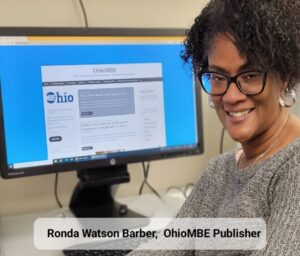
By Ronda Watson Barber
OhioMBE Publisher
For more than two decades, Columbus City Schools operated a supplier diversity program that—while imperfect—played a meaningful role in connecting local minority- and women-owned businesses to district contracting opportunities. It had structure. It had history. It had results.
Under the Angela Chapman administration, that long-standing program didn’t simply weaken. It collapsed.
For more than 20 years, Terri Wise ran the LEDE Outreach program alone — no staff, no administrative support, no team. Her experience, relationships, and institutional memory were the backbone of supplier diversity at CCS. After the program was moved into the Department of Equity, Operations stopped notifying her of contracting meetings, legislation, or project updates. The communication channels essential to supplier diversity were shut down. When she retired, there was no structure, no system, and no functioning process remaining.
Columbus City Schools also paid for a state-of-the-art compliance platform — the same one used by the City of Columbus, CRAA, COTA, and the Columbus Zoo. Terri championed it and introduced it to regional partners who adopted it because it worked. But CCS staff barely used it. Taxpayers funded this tool for years with minimal internal activity. A system designed to track commitments, flag disparities, and ensure accountability sat untouched before it was canceled by an administrator with no supplier diversity expertise. That is not just administrative failure — it is fiscal irresponsibility.
For a year and a half after Terri’s departure, the supplier diversity office went dormant. No LEDE notifications were sent. No outreach occurred. No compliance was monitored. No vendor list was managed. No communication was maintained. But the spending did not slow down.
District reports show $80.9 million in summer construction spending, with only $4.6 million going to African-American firms and more than $17.9 million going to white-owned firms — a nearly 4-to-1 disparity. The LEDE program is not race-based, but the outcomes show clearly who benefits most when outreach stops and systems fail.
Policy 6400 sets a district-wide goal of 20% spend with LEDE vendors. In FY25, CCS reported $232.3 million in controllable spending, with $41.5 million going to LEDE vendors — only 17.9%. Better than FY24, but far from acceptable for a majority-Black district funded significantly by Black taxpayers.
The LEDE application itself is still wrong. It lacks the required affidavit. It includes outdated instructions. It does not match regional certification standards. It contains structural errors. The district keeps insisting it is “building a foundation.” If that’s true, then why is basic information still incorrect? Why is the affidavit still missing? Why can’t staff produce a clean, accurate application? And where is the office actually located?
Community members and vendors shouldn’t need a map and a magnifying glass to find a public-facing program. And the fact that I, a publisher and advocate, understand the program structure better than multiple highly paid employees assigned to it speaks volumes.
The district also hired a consultant, but their assignment was shockingly minimal: audit the outdated vendor list and host one outreach session. It appears the consultant was paid to assist the LEDE Coordinator in completing basic job functions — work fundamental to running any supplier diversity program. This is not capacity-building. It is outsourcing the bare minimum while problems go unaddressed.
Nearly 11 months passed after the new coordinator was hired before a single outreach session occurred — and that event was the consultant-led one. One session cannot support a district of this size. One session cannot rebuild trust. One session cannot replace two decades of consistent vendor engagement.
Outdated materials, misinformation, and public records discrepancies continue to show the depth of the collapse. The Vendor Services website is outdated. The LEDE application is incorrect. Materials handed out at outreach events were outdated. Public records responses didn’t match what vendors received. Policy 6400 remains unenforced. Staff cannot articulate the program structure. A district cannot claim it is “building a foundation” when the bricks are missing and the blueprint is wrong.
At the last board meeting, emotions ran high. The superintendent said, “people’s livelihood is at stake.” And she was right. But where is that same passion for the livelihoods of Black and economically disadvantaged business owners who were shut out of millions in opportunities because the district neglected its own program? Where is the urgency for the LEDE vendors who were never notified? For the firms harmed by misinformation? For the businesses that followed every rule — only to be excluded by silence?
Compassion cannot be selective. Equity cannot be performative.
Supplier diversity at CCS did not fail because the concept was flawed. It failed because leadership neglected it. It failed because communication stopped. It failed because systems went unused. It failed because the people assigned to manage it lacked expertise. It failed because accountability vanished inside the administration. It failed because no one in power protected the program when it mattered most.
A 20-year foundation was not lost — it was abandoned.
just my thoughts…rwb
Discover more from OhioMBE
Subscribe to get the latest posts sent to your email.